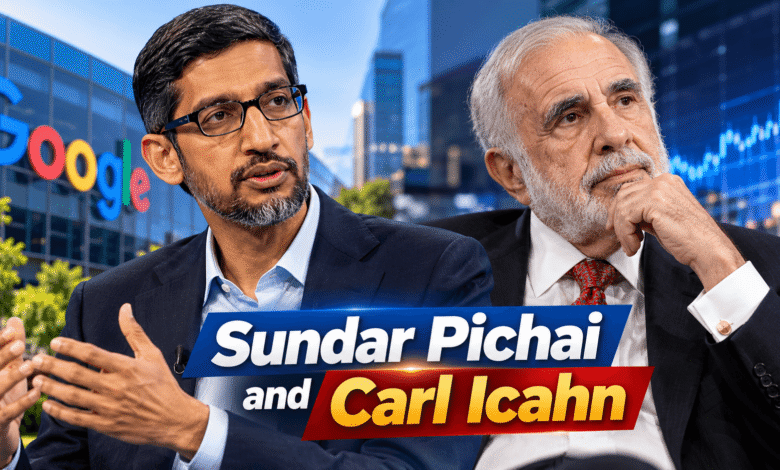
Sundar Pichai and Carl Icahn are two highly recognizable figures in American business, but they built their influence in completely different ways. Pichai rose through the technology world to lead Google and Alphabet, while Icahn became famous as an activist investor who challenged corporate boards and pushed companies toward major changes. Their names sometimes appear together online, leading readers to wonder whether they have worked together, competed, or shared a direct business relationship. The public record, however, points to a much more limited and interesting historical connection.
| Quick Bio | Sundar Pichai | Carl Icahn |
|---|---|---|
| Full Name | Pichai Sundararajan | Carl Celian Icahn |
| Profession | Technology Executive | Investor and Businessman |
| Known For | CEO of Google and Alphabet | Activist Investing |
| Education | IIT Kharagpur, Stanford, Wharton | Princeton University |
| Major Organization | Google / Alphabet | Icahn Enterprises |
| Career Style | Product and corporate leadership | Investment and shareholder activism |
| Key Industry | Technology | Investments and diversified businesses |
Who Are Sundar Pichai and Carl Icahn?
Sundar Pichai is the chief executive of both Google and its parent company, Alphabet. He joined Google in 2004 and gradually became responsible for major products and platforms, including Chrome, Android, Search, Maps, Gmail, and Google Workspace. He became Google’s CEO in 2015 and Alphabet’s CEO in December 2019.
Carl Icahn followed a very different route to prominence. He began his Wall Street career in 1961 and founded Icahn & Co. in 1968, initially focusing on arbitrage and options trading. He later became one of America’s best-known activist investors by acquiring significant positions in companies and pressing management teams and boards for changes.
The contrast between them immediately makes the pairing interesting. Pichai represents executive leadership inside one of the world’s major technology companies, whereas Icahn represents the power that a determined shareholder can exercise from the investment side.
Is There a Direct Sundar Pichai and Carl Icahn Relationship?
There is no well-established public evidence showing that Sundar Pichai and Carl Icahn formed a business partnership, became close personal associates, or regularly worked together. Claims suggesting a major direct relationship between them should therefore be treated carefully.
Their strongest historical connection is indirect and involves Motorola Mobility. Icahn was a significant Motorola Mobility shareholder around the period when Google agreed to acquire the company in 2011, while Pichai was already an important executive working inside Google.
An important detail is often overlooked when this history is discussed. Pichai was not Google’s CEO during the Motorola acquisition process; Larry Page held that position. Available accounts of the transaction also do not establish Pichai as a principal negotiator in Google’s dealings surrounding Icahn and Motorola.
The Motorola Mobility Connection Explained
Motorola Mobility provides the clearest reason Sundar Pichai and Carl Icahn can legitimately appear in the same corporate-history discussion. Icahn held a major position in Motorola Mobility and was actively interested in how the company could generate greater value for shareholders.
Google announced its plan to acquire Motorola Mobility for approximately $12.5 billion in 2011. For Google, the acquisition had strategic importance during a period when Android and the wider mobile technology market were developing rapidly.
Pichai was already rising within Google at this stage of his career. However, associating his later position as Google’s CEO with the 2011 negotiations can create a misleading impression about his personal involvement in the transaction.
The accurate connection is therefore broader. Icahn was an influential Motorola shareholder, while Pichai belonged to the senior leadership ranks of the company that was buying Motorola, but this does not establish a personal partnership between the two men.
Sundar Pichai’s Rise Through Google
Pichai’s career demonstrates how product expertise can eventually develop into company-wide leadership. After joining Google in 2004, he became associated with several products that would become central parts of Google’s global technology ecosystem.
His responsibilities eventually covered products and platforms such as Chrome, Android, Search, Maps, Gmail, and Google Workspace. This experience placed him near the center of Google’s transition from a search-focused company into a much broader technology organization.
In October 2015, Pichai became CEO of Google. Four years later, Google co-founders Larry Page and Sergey Brin announced a simplified leadership structure under which Pichai became CEO of Alphabet as well as Google.
His leadership has increasingly centered on artificial intelligence. Alphabet’s corporate materials describe Pichai as having shifted company strategy toward AI, while Google’s current information identifies him as CEO of both Google and Alphabet.
Carl Icahn’s Influence on Corporate America
Carl Icahn became influential through a strategy very different from Pichai’s. Instead of spending decades climbing through the management structure of one technology corporation, Icahn built substantial investments in companies and frequently challenged their existing strategies.
His investment history includes major names across technology, media, energy, transportation, healthcare, and other industries. Companies associated with his investment career have included Apple, eBay, Yahoo!, Netflix, Dell, Motorola, Hertz, Xerox, and many others.
Icahn’s approach made shareholder activism a major part of his public identity. The basic idea behind such activism is that an investor can acquire a meaningful stake and then seek changes believed to improve the company’s performance or shareholder value.
That approach can place an activist investor in direct discussions with executives and boards. It also explains why Icahn’s name has repeatedly appeared alongside famous corporate leaders throughout his long investing career.
Sundar Pichai and Carl Icahn Represent Different Forms of Power
Looking at Sundar Pichai and Carl Icahn together reveals two very different forms of influence in modern business. Pichai’s authority comes largely from executive responsibility, while Icahn’s influence historically came from ownership, investment positions, and shareholder pressure.
A chief executive must think about employees, products, customers, regulation, competition, investment, and long-term company strategy. Decisions can affect an enormous organization and sometimes billions of users around the world.
An activist investor approaches a corporation from another direction. The investor studies assets, management decisions, capital allocation, corporate structure, and potential weaknesses before deciding whether significant changes could create greater value.
Neither model is identical to the other. Yet both demonstrate how individuals can influence the direction of extremely large companies through different positions within the business system.
Their Different Leadership Styles
Pichai is generally associated with product development, engineering, technology strategy, and large-scale organizational management. His career developed inside Google before he ultimately took responsibility for both Google and Alphabet.
Icahn built his reputation through investment activity and direct challenges to corporate leadership. His history contains numerous examples of taking large positions in companies and seeking strategic, financial, management, or structural changes.
These differences are important when discussing the two men. Calling them business partners would incorrectly blur the distinction between their careers, while describing them as examples of contrasting corporate influence provides a much more accurate picture.
One builds influence by managing a technology organization from within. The other became famous for using investment ownership to influence companies from a shareholder’s position.
Why Do People Search for Sundar Pichai and Carl Icahn?
The combination may appear unusual because the two men belong to different generations and developed their reputations through different areas of business. Google’s enormous influence and Icahn’s history with major technology companies naturally create possible points of curiosity.
The Motorola Mobility story adds a genuine historical intersection. Because Pichai later became the leader most strongly associated with modern Google, readers can easily assume he personally controlled earlier Google transactions.
Corporate timelines matter here. Pichai’s present leadership position should not be projected backward onto every major deal Google completed before he became CEO.
This is why examining dates and roles is essential. It separates a documented corporate connection from assumptions that may arise simply because two famous names appear in the same business history.
Did Carl Icahn Invest in Technology Companies?
Yes. Technology and technology-related companies have repeatedly appeared in Icahn’s investment history. His publicly documented positions over the decades included companies such as Apple, eBay, Yahoo!, Dell, Netflix, Motorola, and others.
This history explains why Icahn frequently appears in discussions involving Silicon Valley and major technology executives. He was not primarily a technology company founder, but investment activity brought him into contact with many businesses operating in or around the sector.
His involvement could also attract considerable attention because activist campaigns sometimes challenged established corporate strategies. Investors, directors, executives, and analysts closely watched what changes Icahn was seeking.
Pichai’s influence works differently. Instead of investing across numerous outside companies, his public career has been deeply connected with Google’s products, operations, and long-term technological direction.
What Makes Their Stories Interesting?
Sundar Pichai’s career illustrates the journey from product management to leadership of one of the world’s most important technology groups. His rise also reflects how technical understanding and management experience can combine at the highest corporate level.
Carl Icahn’s career demonstrates another route to enormous business influence. His reputation developed from investing, identifying companies where he saw opportunities for change, and using shareholder power to challenge corporate decisions.
Their stories therefore provide an interesting comparison even without a major personal relationship. Both have participated in corporate America at extremely high levels, but the sources of their authority could hardly be more different.
The Motorola episode simply gives those separate histories a real point of intersection. It should be understood as an indirect corporate connection rather than evidence of a long-running Pichai-Icahn partnership.
Frequently Asked Questions
Did Sundar Pichai and Carl Icahn work together?
There is no established public record showing a significant direct working partnership between them. Their most notable connection is indirect and relates to Motorola Mobility during the period when Google moved to acquire the company.
Was Sundar Pichai Google’s CEO during the Motorola deal?
No. Pichai became Google’s CEO in 2015. Google’s agreement to acquire Motorola Mobility was announced in 2011, when Larry Page was Google’s CEO.
What is Sundar Pichai best known for?
Pichai is best known for leading Google and Alphabet. Before becoming CEO, he held leadership responsibilities involving major Google products and platforms, including Chrome and Android.
What is Carl Icahn best known for?
Icahn is best known as an activist investor. His decades-long career involved taking substantial positions in companies and seeking changes intended to increase corporate or shareholder value.
Are Sundar Pichai and Carl Icahn business partners?
There is no credible public evidence establishing them as business partners. Their careers are better understood as separate paths that indirectly intersected through major events in the technology industry.
Final Thoughts on Sundar Pichai and Carl Icahn
The story of Sundar Pichai and Carl Icahn is more interesting when separated from speculation. They are major business figures, but their careers developed independently and through fundamentally different methods of gaining influence.
Pichai became a powerful technology executive through years of product and organizational leadership at Google. Icahn became one of America’s most recognizable activist investors through decades of acquiring stakes and challenging corporate strategies.
Their clearest connection comes from the history surrounding Motorola Mobility and Google’s acquisition of the company. Even there, the evidence supports an indirect corporate link rather than a direct partnership between the two men.
Ultimately, Sundar Pichai and Carl Icahn represent two sides of modern corporate power: the executive responsible for building and directing a business, and the investor capable of influencing businesses through ownership and shareholder activism.